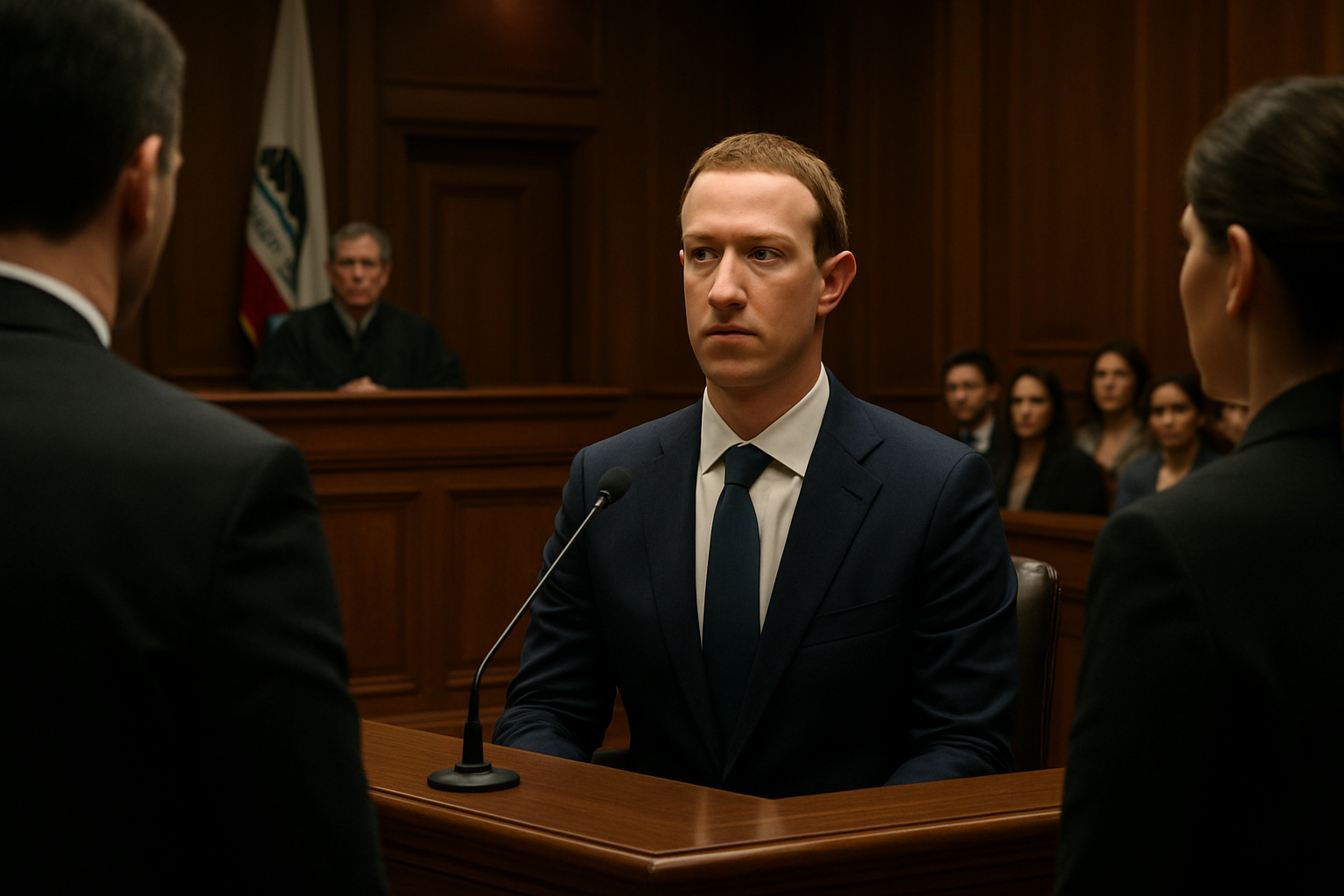
Mark Zuckerberg appeared in a Los Angeles courtroom Wednesday for the first time to testify about Instagram's impact on youth mental health, facing tough questioning in a landmark trial that could reshape how social media platforms are held accountable for user harm.
The Meta CEO's testimony centers on a lawsuit brought by a 20-year-old woman identified as KGM, who alleges that her early use of Instagram created an addiction that exacerbated depression and suicidal thoughts during her teenage years. The case represents one of the most significant legal challenges to Big Tech's legal protections against user harm claims.
Courtroom Confrontation Over Design Features
During Wednesday's proceedings, plaintiff attorney Mark Lanier confronted Zuckerberg with internal emails from 2014 and 2015 showing the Meta founder had set explicit goals to increase user engagement time by double-digit percentage points. The lawyer suggested Zuckerberg had misled Congress during 2024 hearings where he testified that Meta did not design its platforms to maximize screen time.
"If you are trying to say my testimony was not accurate, I strongly disagree with that."
— Mark Zuckerberg, Meta CEO
Zuckerberg pushed back against accusations of dishonesty, stating that while Meta previously had engagement-related goals, the company has since changed its approach to prioritize user wellbeing over time spent on platforms.
The testimony comes as Meta Platforms and Google's YouTube remain the sole defendants in the case, after TikTok and Snap settled earlier claims. The trial's outcome could establish crucial precedents for how courts evaluate social media companies' responsibility for user harm, particularly among vulnerable young populations.
Global Regulatory Revolution
Zuckerberg's court appearance occurs amid the most significant wave of social media regulation in internet history. Across multiple continents, governments are implementing unprecedented restrictions targeting platform design and youth protection.
Spain has announced the world's most aggressive regulatory framework, including complete social media bans for users under 16 and criminal liability for platform executives—a measure that could result in imprisonment for tech leaders found guilty of violations. The framework also mandates biometric age verification and legally defines algorithmic manipulation for the first time.
Australia's under-16 social media ban, implemented in December 2025, has already eliminated 4.7 million teen accounts, proving that large-scale restrictions are technically feasible with sufficient government commitment. The success of Australia's model is being closely studied by European nations considering similar measures.
Scientific Evidence Against Platforms
The legal challenges are supported by mounting scientific evidence about social media's impact on child development. Dr. Ran Barzilay's research at the University of Pennsylvania demonstrates that early smartphone exposure before age 5 causes sleep disorders, weight problems, and cognitive decline.
Global statistics reveal the scope of the problem: 96% of children aged 10-15 use social media, with 70% experiencing harmful content exposure and over 50% encountering cyberbullying. Large-scale U.S. studies show that children spending four or more hours daily on screens face a 61% increased risk of depression.
University of Macau researchers have documented that short-form video content consumption through smartphone scrolling negatively impacts cognitive development, causing social anxiety, insecurity, and academic disengagement among young users.
Industry Pushback and Market Impact
The regulatory pressure has triggered fierce resistance from technology executives. Elon Musk has characterized European measures as "fascist totalitarian" overreach, while Telegram's Pavel Durov has warned of "surveillance state" implications. This opposition is being used by government officials as evidence supporting the need for stronger regulatory intervention.
The uncertainty has contributed to what industry observers are calling the "SaaSpocalypse"—a February 2026 market disruption that has eliminated hundreds of billions in technology company valuations as investors grapple with the potential impact of global regulatory coordination.
Defense Strategies and Technical Challenges
Instagram CEO Adam Mosseri previously testified in the same Los Angeles court, arguing that users cannot be "clinically addicted" to social media platforms. The company's defense strategy distinguishes between clinical addiction—a medically recognized condition—and "problematic use" of social platforms.
Meta argues that features like infinite scroll, autoplay, and algorithmic curation represent standard industry practices designed to enhance user experience rather than create harmful dependencies. The company maintains that these design choices serve legitimate business purposes and user preferences.
However, implementation of new regulatory requirements faces significant technical obstacles. Real age verification systems require biometric authentication, raising privacy concerns about government surveillance capabilities. The global semiconductor shortage, with memory chip prices surging sixfold, is constraining the infrastructure needed for comprehensive age verification until new fabrication facilities come online in 2027.
International Coordination Prevents Forum Shopping
The coordinated timing of regulatory measures across multiple jurisdictions represents a sophisticated strategy to prevent "jurisdictional shopping," where platforms might relocate operations to avoid stringent rules. Greece is approaching under-15 restrictions through its Kids Wallet application, while France, Denmark, and Austria are conducting formal consultations on similar measures.
The European Commission has found TikTok in violation of the Digital Services Act for employing "addictive design" features, with potential penalties reaching 6% of global revenue—billions of dollars for a platform of TikTok's scale. These findings provide legal precedent for the broader regulatory campaign.
Stakes for Democratic Governance
Legal and policy experts view 2026 as a critical inflection point that will determine whether democratic institutions can effectively regulate multinational technology platforms while preserving the benefits of digital connectivity. The outcome affects fundamental questions about childhood development, human agency, and democratic accountability in the digital age.
Cross-border enforcement requires unprecedented international cooperation, as platforms operate across multiple jurisdictions with varying regulatory frameworks. The success or failure of current initiatives will likely influence technology governance precedents for decades to come.
Alternative approaches are emerging in different regions. Malaysia emphasizes parental responsibility through digital safety campaigns rather than regulatory bans, while Oman has implemented "Smart tech, safe choices" education focusing on conscious digital awareness. This represents a philosophical divide between government intervention and individual agency in digital governance.
Implications for Platform Accountability
The Los Angeles trial continues for several weeks, with additional Meta executives, researchers, and technical experts expected to testify. The case could establish whether social media companies can be held legally responsible for design features that allegedly harm users, particularly children.
If successful, the lawsuit could trigger a wave of similar litigation and strengthen arguments for criminal liability frameworks like Spain's executive imprisonment model. Conversely, a victory for Meta might reinforce industry arguments against regulation and bolster claims that platform design choices are protected business decisions.
The trial occurs as governments worldwide grapple with balancing child protection, digital rights, and economic competitiveness. The resolution will likely influence regulatory approaches globally, potentially determining whether the 21st century sees increased corporate accountability or reinforced technological sovereignty.
As Zuckerberg's testimony continues, the international community watches closely for signals about how democratic societies will navigate the complex intersection of technology, childhood development, and governmental authority in an increasingly connected world.